Custom Artist Website vs DIY Builders: Should You Build It Yourself?
Building your own artist website on a template builder can work. Here is what a done-for-you custom site on your own domain changes, and how to decide which path fits your studio.
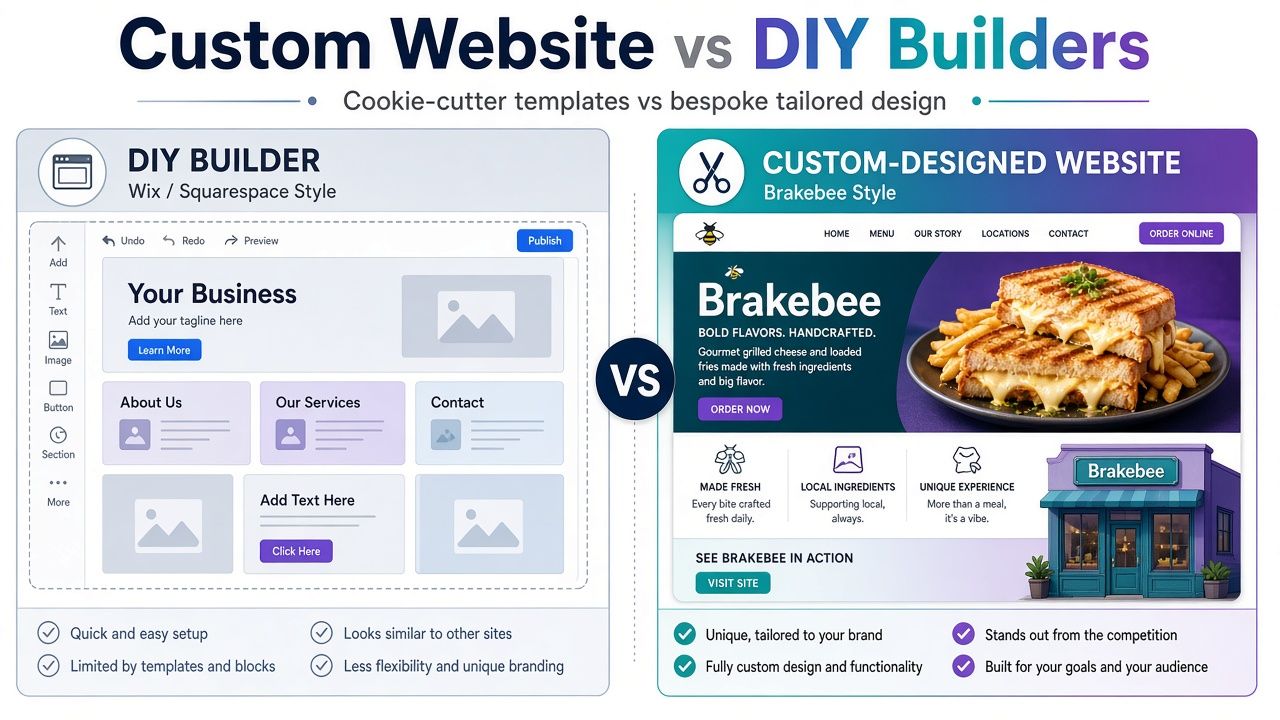
Good artist website design does two jobs at once. It has to look like your work, and it has to sell your work. Most artists reach the same fork early on: build the site yourself on a template builder, or have someone design and run a custom site for you on your own domain.
Both paths can work. This guide compares them on the things that matter to a working artist, from time and design to checkout, prints and upkeep, so you can pick the one that fits your studio.
What a DIY website builder gives you
A DIY builder hands you a template, a drag-and-drop editor and hosting. You pick a theme, upload images, write your pages and connect a domain. If you like tinkering and have the hours, it gives you a lot of control, and many artists start there.
The trade-off is that you become the web designer, the shop manager and the support desk. Every theme change, product listing, plugin and checkout setting is yours to set up and keep working. For a closer look at the builders themselves, see our guide to the best website builders for artists.
What a done-for-you custom artist website gives you
With a custom site, a team designs the site around your brand and builds it for you. Brakebee Custom Sites works this way. You answer a few questions about your studio, Brakebee designs a private site for you, and a first draft usually arrives in four to seven days. You approve it before it goes live.¹
The site runs on the Brakebee platform, so it comes connected to the rest of your art business:¹,²
- Your own domain. The site lives at yourname.com.
- Shop and checkout. Cart, checkout and your live catalog launch with the site, and orders flow into one order desk.
- The Brakebee marketplace. Your work can also appear on the curated Brakebee marketplace from the same catalog.
- Print on demand. Brakebee prints and ships canvas and aluminum metal prints from its Phoenix lab, so print orders get fulfilled without you touching them.³
- Connectors. Bring in a catalog you already built elsewhere, and list your work on channels such as Etsy, Shopify, Square, Faire and other marketplaces from one catalog.³,⁴
- Marketing tools. Social Central shows your feeds on the site, and the free articles feature lets you publish your own news.
- Art fairs and events. Run your events from the Brakebee dashboard and point fair visitors to your own domain.
- Wholesale. One add-on turns on a wholesale line with its own price tiers.
- Image protection and AI search. Right-click is disabled, most screenshots show a blank box, and the site is set up so AI assistants can learn who you are.
Custom artist website vs DIY builder at a glance
| Part of the site | DIY website builder | Brakebee custom site |
|---|---|---|
| Design | You pick a template and adjust it | A private design made to match your brand |
| Who builds it | You do | Brakebee designs and builds it for you |
| Time to launch | Depends on your free evenings | A first draft in about 4 to 7 days |
| Domain | You buy it and connect it yourself | Your own domain, with help pointing or securing it |
| Selling | Shop apps and payment setup are on you | Cart, checkout and catalog live at launch |
| Prints | You find a print partner and connect it | Print on demand from the Phoenix lab |
| Other sales channels | Separate setups for each marketplace | Brakebee marketplace plus connectors from one catalog |
| Wholesale | Usually a separate tool | One add-on, one catalog, multiple price tiers |
| Upkeep and support | Updates and fixes are yours | The same team stays on after launch |
Your custom domain is the asset that lasts
Whichever path you choose, put your site on your own domain. The address on your business cards, hang tags and booth signs is the one thing that follows you across every show, platform change and redesign. A domain you own keeps your name and your search history building value under your own brand.
On a DIY builder, connecting a domain is a settings task you handle yourself. With Brakebee Custom Sites, your site starts on a yoursite.brakebee.com address during setup, and Brakebee then helps you point your own domain at it. If you already own a domain, you bring it. If you don't, Brakebee can help you secure one.¹
Moving from an older site? Brakebee maps your old URLs to the new ones and points search engines at the new pages, so the search authority you have already earned carries over.¹
What a custom artist website costs
The cost of a custom site depends on three things. The first is design scope, meaning how many pages, features and custom touches your site needs. The second is your domain, since you can bring one you already own or have Brakebee help you secure and manage one. The third is catalog setup, because you can add your pieces yourself in the dashboard, have Brakebee load them for you, or import a catalog you already built elsewhere through a connector.¹
Brakebee keeps current pricing on its Custom Sites page, where you can request a quote or book a short call before you enroll.¹ When you compare a custom site with a DIY builder, count your own hours along with the subscription. Theme work, product listings, print setup and fixes all come out of studio time.
When building it yourself makes sense
A DIY builder can be the right call when:
- you enjoy web design and want to change layouts often
- you mainly need a portfolio and don't plan to sell online yet
- you already have a print partner, a payment setup and the time to run them
When a custom site makes more sense
A done-for-you site usually fits better when:
- you want a site that looks like your brand without learning a builder
- you sell originals, prints or wholesale and want one catalog behind all of it
- art fairs keep you on the road, and the site needs to keep selling while you're away
- you want the same team on hand after launch for changes and new features
You can see real examples on the Custom Sites page, including Meyerdirk Art at meyerdirkart.com.¹
Get a quote for your custom site
Want the whole business run for you?
A custom site covers your website. Some artists want more and would like Brakebee to run the full online side of their line, including marketing, marketplaces, wholesale and the site itself. That is what Brakebee Managed Lines does, as an ongoing partnership.²
To learn more, read what's included in Managed Lines, how Managed Lines works and why some artists move from Shopify to Managed Lines.
The short version
A DIY website builder gives you control in exchange for your time. A custom artist website gives you a designed, selling site on your own domain, connected to prints, marketplaces, wholesale and events, with a team that stays on after launch. If your hours belong in the studio and the booth, start with Brakebee Custom Sites.
Related reading
- How to build an artist portfolio website that sells
- Best website builders for artists
- How to sell art online
¹ Brakebee, "Custom sites for artists," https://brakebee.com/custom-sites (accessed October 15, 2026).
² Brakebee, "Managed Lines," https://brakebee.com/managed-lines (accessed October 15, 2026).
³ Brakebee, "Print on demand," https://brakebee.com/print-on-demand (accessed October 15, 2026).
⁴ Brakebee, "Makers," https://brakebee.com/makers (accessed October 15, 2026).