
How to Sell Prints of Your Art Online: A Step-by-Step Guide
Learn how to sell art prints online profitably. From choosing a print lab to marketing strategies, this guide covers everything artists need to know.
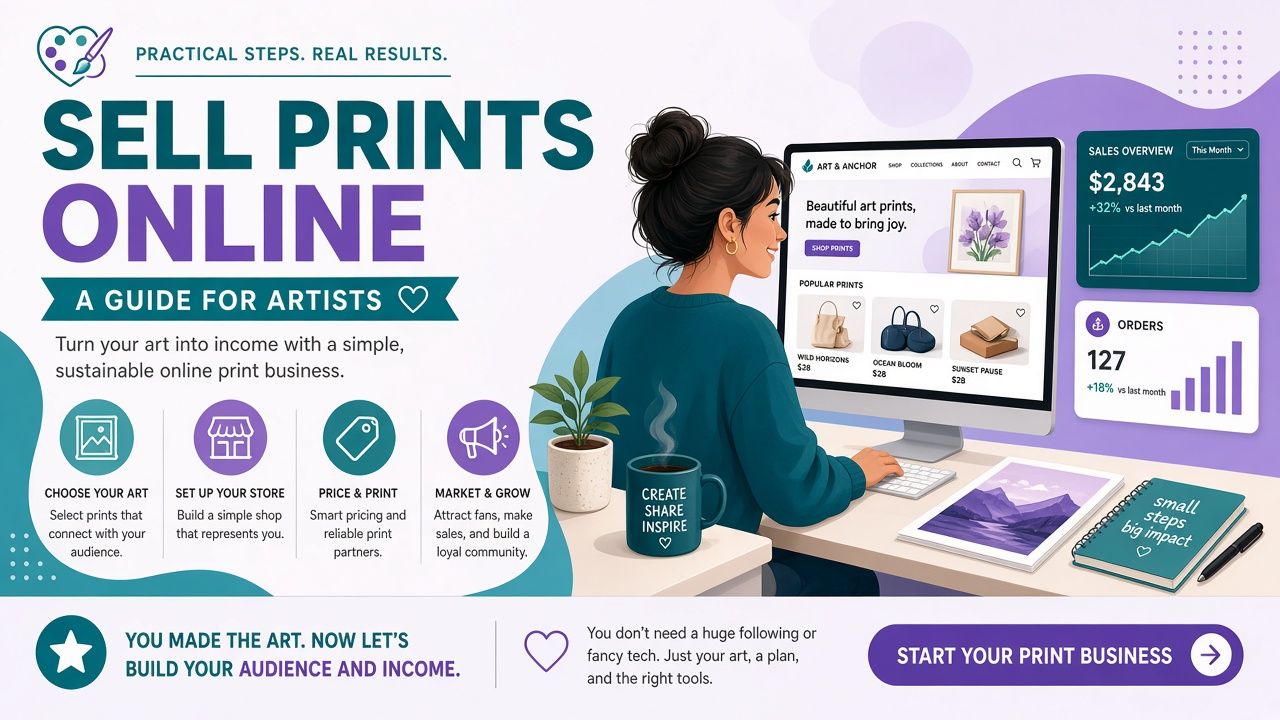
Selling prints is one of the most reliable ways for an artist to earn from a single piece more than once. A well-made print of a painting can hang in many homes, at a price more people can say yes to. If you have ever wondered how to sell prints of your art online, the good news is that the path is clearer than it looks, and most of it comes down to a series of practical decisions you can make one at a time.
This guide walks through ten steps, from choosing which pieces to print all the way to tracking what sells and growing from there. It focuses on print-on-demand, since that is the simplest way for most artists to start selling art prints online without buying inventory first. If you want a quick overview of how Brakebee's version works, our print-on-demand for artists page covers the basics, and this article goes deeper into the whole process.
Step 1: Pick which artworks to offer as prints
Start with the pieces people already respond to. Look at the work that gets the most comments, questions and shares, and the originals that sold quickly or drew interest after they were gone. Those are your strongest candidates, because buyers have already told you they care about them.
Think about how each piece will read on a wall at print size. Bold compositions, strong color and clear subjects tend to hold up well across many sizes, while very fine detail may need a larger print to shine. Work with a lot of texture, such as heavy impasto, can still make a lovely print, though the print shows a flat image of that texture, so describe it honestly in your listing.
It helps to launch with a small, cohesive group of pieces. A handful of related pieces makes your shop feel curated, gives buyers an easy way to pick a pair or a set, and lets you learn what sells before you add more.
Step 2: Make print-ready files
Your print can only be as good as the file behind it. For flat work such as drawings, watercolors and small paintings, a flatbed scan usually captures the most accurate color and detail. Larger or textured pieces are often better photographed with even, diffused light from both sides, the camera square to the artwork, and a color reference card in the frame so you can correct color afterward.
Edit gently. Crop to the edge of the art, straighten any tilt, and adjust color so the file matches the original when you view them side by side. Save a full-resolution master file and keep it safe, since every print you sell will come from it.
Check your aspect ratio early. Standard print sizes come in a few common proportions, and a piece that does not match one of them will need either a crop or a border. Deciding this now saves surprises when you set up products later. If you are unsure whether your file is sharp enough for larger sizes, order a sample at the biggest size you plan to sell and look at it closely.
Step 3: Choose how your prints get made and shipped
You have two broad ways to fulfill orders. You can order a batch of prints from a lab, store them and ship each sale yourself, or you can use print-on-demand, where each print is made only after a customer orders it and ships straight to them.
Print-on-demand
Each print is made after a sale and shipped directly to your buyer, so you can offer every size and finish without holding stock.
Bulk lab order
You buy a batch up front, keep it on hand and pack every order yourself, which suits art fairs, wholesale and hands-on quality checks.
For most artists selling online, print-on-demand removes the two biggest headaches of selling prints, which are paying for stock before anyone buys it and spending evenings at the packing table. We compare the two models in detail in print lab vs print-on-demand, including when a mix of both makes sense.
Step 4: Choose sizes, finishes and products
Offering a few thoughtful choices helps buyers find the version that fits their space. Give them a small, medium and large option of each piece to start, and add more sizes once you see where demand is.
The finish changes how a piece looks and feels on the wall, so match each artwork to the surfaces that flatter it.
| Finish | What it looks like | Works well for |
|---|---|---|
| Aluminum, gloss | Vivid, luminous color with a modern shine | Bold color, photography, graphic work |
| Aluminum, satin | Rich color with a softer sheen | Most artwork where you want some glow without glare |
| Aluminum, matte | Smooth, low-reflection surface | Bright rooms and subtle palettes |
| Photo print, gloss | Crisp detail and punchy color | Photography and high-contrast pieces |
| Photo print, matte | Soft, glare-free look | Framed work and quieter images |
| Gallery wrap canvas | Image wraps around the edges, ready to hang | Paintings and work with a traditional feel |
| Giclee | Fine art print with smooth tonal range | Watercolor, drawing and detailed painting |
Beyond wall art, many artists add smaller products that let fans buy in at a lower commitment. Notecards, coasters, calendars and keychains featuring your work make easy gifts and can introduce new people to your art.
Step 5: Choose where to sell
Buyers need a place to find and purchase your prints. Most artists combine a shop they control with a few marketplaces where shoppers already browse. Your own shop gives you a home base to tell your story and keep your branding consistent, and marketplaces put your work in front of people who are actively looking for art and gifts.
When comparing print-on-demand platforms, look at who sets your retail price, how and when you get paid, which finishes are available and which sales channels you can connect. Our guide to the best print-on-demand for artists lines up seven options side by side so you can compare them on the points that matter to you.
If you would like a fully branded artist website as your home base, Brakebee also builds custom artist sites for $500/year, with a one-time setup quoted before work starts.
Step 6: Price your prints
Pricing feels personal, but a simple method keeps it grounded. Start with what each print costs you to produce and ship, add any platform or payment fees, then add the profit you want to earn on every sale. That total is your floor, and you should never sell below it.
From there, look at artists whose style, experience and audience are similar to yours, and see where their prints sit. Pricing in the same neighborhood helps buyers feel confident, and your own sales will tell you over time whether to move up.
Does my price cover every cost?
Include production, shipping, platform fees and payment fees before you add profit.
Am I earning enough on each sale to make it worthwhile?
Set a profit amount you are happy with and build it into every size.
Do my larger sizes and premium finishes reflect their value?
Price each size and finish on its own math so every option earns its keep.
How do I compare with similar artists?
Look at artists with a comparable style and audience and aim for the same range.
Will I be comfortable running a sale later?
Leave enough room in your profit that an occasional promotion still pays you.]
See how print-on-demand works for artists
Step 10: Track what sells and grow
After your first few weeks of sales, patterns start to appear. Note which images, sizes and finishes sell most often, which channels bring the most orders, and which listings get views without converting. Double down on what works by adding sizes or finishes to your best sellers, and refresh or retire what does not move.
Growth from here is usually a matter of steady additions. Add a few new pieces at a time, connect another sales channel when you are ready, and keep listening to what your buyers tell you through their orders.
How Brakebee helps you sell prints
Brakebee's print-on-demand is built for artists selling their own work. You can offer dozens of print sizes in gloss, satin and matte aluminum, gloss or matte photo prints, gallery wrap canvas and giclée, and archival inks are used for artist prints. You can also turn your designs into custom products such as keychains, notecards, printed decor, coasters, calendars and coloring books.
Orders usually turn around in hours to a day, and you are paid after products ship. Along with your Brakebee shop, you can connect marketplaces including Etsy, Shopify, TikTok Shop, Wayfair, Walmart, Amazon, eBay and Faire, with more coming soon. Learn more on the Brakebee print-on-demand page.
Frequently asked questions
Do I need to buy inventory to sell prints of my art?
With print-on-demand you don't, because each print is made after a customer orders it.
What file do I need to sell art prints online?
A high-resolution scan or photo of your artwork with accurate color, cropped to the edges of the piece.
Which print finish should I offer first?
Choose the finish that best suits each artwork, then add others as you learn what your buyers prefer.
Where should I sell my art prints?
Most artists combine their own shop with a few marketplaces where art buyers already shop.
How do I know my prints look good before customers get them?
Order a sample of each new print and check it against the original in good light.]
Start selling your prints
You do not have to finish every step perfectly before you begin. Pick a few strong pieces, prepare good files, choose your finishes and get your first prints listed, then let your buyers guide what comes next.
Sources: Custom Sites "$500/year" with one-time setup quoted: brakebee.com/custom-sites, verified Oct 13, 2026. Brakebee print sizes, finishes, custom products, marketplace connectors, payout timing, turnaround, archival inks for artist prints and limited edition runs: Brakebee, confirmed Oct 13, 2026. No competitor or third-party claims are made in this article.