
How do I sell my art?
Artists who sell more usually run several fronts at once — a marketplace like Etsy, their own shop, social, fairs, and sometimes wholesale. You don't need to become a marketing pro; you just need the work to exist where people can find it, in one cohesive catalog you don't have to rebuild every week.
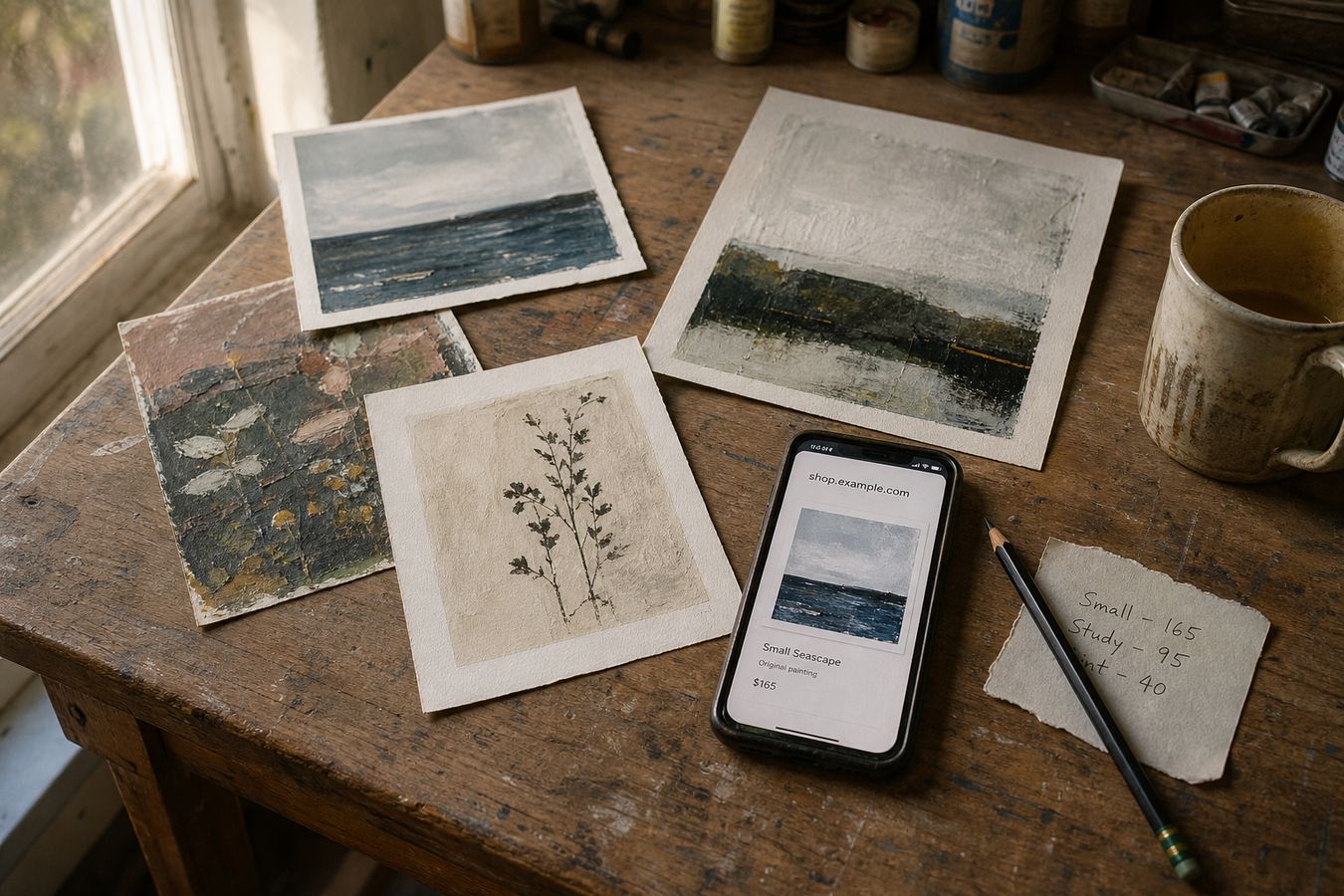
When an artist asks how to sell art, the blunt answer is simple; People only buy what they know exists, and they don't know about your art yet. So lets ix that.
If you are already making the work, but not selling it, you are missing a simple path from 'I made this' to someone who would want this can find it and pay. Successful artists rarely pick one magic outlet. They use a package of fronts - a marketplace, a shop they control, social media, a few fairs & festivals, and some galleries or a wholesale buyer. Importantly they keep the catalog in one place so listing does not eat the hours they need to create.
You don't need a million followers. You need a few people who like your look, plus enough public doors that new people can find that look.
What do artists who sell actually do?
They make the work. Then they put it where buyers already look.
Typical mix, not a mandatory checklist:
- A marketplace with built-in shoppers (Etsy is the one most artists have already tried, and it is still a fair place to start)
- A shop with your name on it, so a friend or fan can open one link
- Social posts that point at that shop, not at a dead-end photo
- A few fairs or in-person days where strangers can hold the work
- Wholesale later, when the same piece can be ordered more than once in reproduction mode
Brakebee is built so those fronts can share one catalog, one profile, and one checkout — instead of five logins and five product entries. Start with a free account. Add only what you need.
Do I have to become a marketing Superstar?
No. That fear is why a lot of good work never leaves the studio. You just need to take the fist step.
Marketing at this stage is not a content calendar and a funnel diagram. It is three unglamorous habits:
- Keep a public shop current.
- Tell the people who already like your work that the shop exists, and ask them to pass the link on.
- Show up in one or two places strangers already browse — a marketplace, a fair, a social account you can stand to use.
Curate the people who love what you do. Don't spend the year performing for people who will never buy. Fifty serious fans who might buy are far more valuable base than a million followers who will never purchase your work. Exposure still matters; it's how the next few people who would love the work find you. This step is about starting to move beyond your inner circle of friends & family.
Why Etsy still belongs in the conversation
We like Etsy. A lot of artists should keep using it. And it's worth testing for everyone.
Etsy is good at one thing most personal sites are not: massive numbers of people already go there to browse and buy handmade and art-adjacent work. If you have never sold online, that built-in traffic is a real advantage. The tradeoff is the usual one — extreme competition, higher fees, strict rules, and a customer who often stays loyal to Etsy instead of becoming your customer.
Treat Etsy as a door, not as your whole business. List there if it still earns its keep, but don't stay if its not working for you.
Brakebee’s marketplace is a different door: juried, art-forward, flat commission when you sell, processing included, no monthly listing fee. Acceptance is not instant. When you are accepted you can sell on the marketplace and you receive the Verified Artist badge as part of that same step. The catalog you build for your own shop is the same catalog that can sit on the marketplace. Brakbeee's focus is on curation, art and helping artist grow.
You can also connect Etsy as a marketplace channel inside Brakebee when you want that listing to stay in sync instead of spending all your time trying to juggle inventory. That connector is an add-on; you will see it after you sign up.
Do I need my own website?
You can start without a custom web address if you want something free to start. But you should not stay without a shop people can bookmark. Custom domain's are relatively inexpensive and easy to connect to the Brakebee website platform.
A marketplace listing is rented attention. Your shop is the page you hand to a collector, a festival customer, or your aunt who keeps asking “where do I buy that?” Keep your own traffic on your own site.
On Brakebee, a free account includes a shop at yourname.brakebee.com: catalog, product pages, about/bio, collections, checkout, contact form. That is enough to sell. If you want your own web address and more design control, upgrading is easy.
We like Shopify, and we know WordPress well. They are strong general website tools but they take a lot of maintenance. An artist selling their own work usually needs a catalog, pages, a cart, checkout, shipping, a contact form, and a public address. That shop is here. Be careful with big hosts that look cheap on month one. A contact form, wholesale tools, and marketplace sync are often separate products stacked on later. Compare the real monthly pile, not the starter tile. On Brakebee those pieces are included in the basic package.
Once your site is built, that same catalog can also feed the marketplace, festival inventory, print-on-demand, and Wholesale Market. Ned more granular control? You can even allocate certain inventory to certain markets to automate as fast as you grow.
How should I use social without living there?
Social is how people hear that something new exists. For most artists, its not a good store.
Post the work. Talk like a person. Point every bio and caption you can stand at your website or a specific product link. You don't need a million followers. You need a cadence you will keep and a link that works.
Brakebee helps automate this too:
- Connect your accounts to Brakebee Social Central and let our AI assistants build posts, schedule them, post them and pull in analytics so you know what works. The more you use it, the smarter it gets about your brand.
- If you're looking for some extra exposure, feed your content into our Social Discovery tool. Brakebee will parse through, find work from member artists and attribute it back so you get fresh eyes on your work.
What about festival and selling in person?
Fairs and festivals are still how a lot of artists meet the humans who become repeat buyers. Apply from the Brakebee dashboard with a reusable packet so you are not rewriting the same artist story for every promoter. Public listings live at brakebee.com/events.
Brakebee offers a simple Point-of-sale system that lets you sell in your booth and keep your inventory in sync. When you sell an original, we remove that original form your connected marketplaces near real time. Don't sell an original on Etsy three days after you sold in your booth because you missed an inventory update. Sync it together with Brakebee.
When does wholesale make sense?
When the same piece can leave the studio more than once without you reinventing the order process. For some, this mean finding a process to create near-identical pieces repeatedly. For others it mean outsourcing prints or reproductions. Brakebee offers a full print lab, has associations with several foundries, and can offer domestic reproduction services in metal and wood for artists looking at expanding their footprint in the wholesale world.
Brakebee Wholesale Market: wholesale prices, volume tiers, minimums, visibility to stores and galleries who apply at brakebee.com/buy-wholesale-art. You fulfill your own stocked work or use Brakebee Fulfillment Services. This is an add-on.
Print services: Order a batch from the lab for the booth or to ship on your own and set up print-on-demand so Brakebee can print & ship orders as they funnel in.
The Missing Step for Most Artist
1. Build it.
2. Tell people about it.
3. Sell what sells.
4. Make the next thing.
That second step is the one artists skip because it feels like “marketing.” It seems like a whole new skillset to learn. Brakebee simplifies it. On Brakebee the extra step is: add it to the catalog. Our automations with marketplaces, social central and access to in-person events take the heat off the
We can't promise that listing it will sell it - nobody can. But hiding it guarantees that it won't.
How do I start?
- Create the free account. Fill the profile so people can meet you virtually.
- Add a handful of pieces to the catalog with real photos and a price. Our AI systems help you with the technical parts like descriptions.
- Open your website at yourname.brakebee.com and send that link to the people who already paid you or already ask about the work. Ask them to pass it on. Connect a domain if you want, or wait until later to keep the site free for now.
- Apply to the marketplace when you're ready for a little more exposure.
- Keep Etsy or Instagram if they are already working. Point them at the same shop. Add connectors or Social Central only when the manual double-entry starts to hurt or you want your inventory in sync.
- Keep making the work. That's the important part. Brakebee will help with the rest.
More on the artist path: brakebee.com/makers.
Questions artists ask next
How do I sell more art?
Use more than one door, and stop rebuilding the catalog for each door. Marketplace, your shop, social, fairs & festivals, wholesale when you are ready. Automate those connections so you can focus on creating.
Why isn’t anyone buying my work?
Usually because not enough of the right people know it exists. A website nobody has heard of, a listing nobody can find, and a studio full of finished pieces are the same problem. Post on Brakebee, connect your marketplaces, publish your Brakbee store and website links to socials.
Do I have to quit my job to do this?
No. Take the work public while the paycheck still holds the floor. A full-time living is not the first milestone. A shop people can actually find is.
Is Brakebee instead of Etsy or Shopify?
As you grow, yes - run it all rom one dashboard and own your own sales. To start, it can sit beside them. Etsy is still useful for discovery. Shopify and WordPress are still fine general website tools if you dont mind the extra work. When you're ready for a unified catalog across your website, the marketplace, in-person events, and wholesale, that is the job this platform is for.
What does it cost to start?
It's FREE! No, really... signing up for a profile, building your catalog and setting up a basic website is free. Selling on the Brakebee marketplace is a flat commission only when you make a sale, processing included - no listing fees, ad fees or other unknown fees to surprise you. Your own web address and the other extras are named add-ons you turn on later.